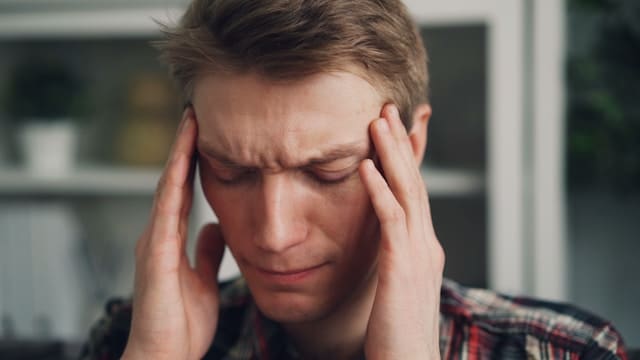

Quick Remedy Finder for Tension Headaches
Tension headaches become much easier to differentiate when you look at the shape of the pressure, where it begins, what the neck/jaw/eyes are doing, what triggered it, and what actually releases it.
- Scutellaria lateriflora – Dull, pressing, band-like headache from mental overwork, worry, prolonged study or poor sleep. Forehead and temples feel full or constricted rather than violently throbbing; fresh air, a short rest and a quieter environment help. [1]
- Niccolum metallicum – Pressing brow-band headache that spreads into the nape and between the shoulders after screens, reading, artificial light or long desk work. Better stopping close work, looking into the distance, cool air, darkness, brow pressure and neck support. [2]
- Physostigma venenosum – Headache driven by eye strain and accommodation: reading or close work quickly produces a pressing band across the brow, sometimes with nausea/sweating. Closing the eyes, darkness, lying down and gentle pressure relieve. [3]
- Cimicifuga – Tension concentrated at the neck–occiput–shoulder junction, with a tight-band feeling, “crick” in the neck or pains travelling from nape to vertex. Cold draughts and jar aggravate; warmth, pressure and slow stretching help. [4]
- Staphisagria – Temples feel compressed by a band after swallowed anger, humiliation, criticism or emotional restraint; occipital aching and neck stiffness can accompany. Better after food, gentle walking, emotional release and resting the eyes. [5]
- Kali phosphoricum – Pressing/heavy headache from mental exhaustion, worry, study or prolonged emotional strain, often with tired eyes, mental dullness, noise sensitivity and a depleted rather than tense-and-angry state. Rest, quiet, warmth, food and short sleep help. [6]
Additional differentials: Anacardium orientale for a tight-band pressure headache from mental exertion that is distinctly better after eating; Magnesium phosphate for crampy/neuralgic head pain that demands heat and firm pressure; Bryonia for a bursting/pressing headache that is worse from the slightest movement and better binding/pressure and absolute rest; Epiphegus for an exertion-triggered occiput-to-left-eye headache relieved by pressure and sleep but with more migraine-like nausea/light sensitivity; and Argentum nitricum for pressure headaches worsened by anticipation, heat and study but relieved by cool air, walking and firm binding. [7][8][9][10][11]
What a tension-type headache usually feels like
Tension-type headache is typically bilateral, pressing or tightening rather than pulsating, mild to moderate, and not made markedly worse by ordinary activity such as walking or climbing stairs. Nausea and vomiting are not typical, although mild light or sound sensitivity can occur. [13]
The NHS describes the everyday version in similar language: pain on both sides of the head, face or neck, often like something pressing or tightening around the head, with scalp/head tenderness in some people. Episodes can last from around 30 minutes to several days. [12]
If the pain is strongly one-sided and throbbing, routine activity clearly worsens it, or nausea/vomiting plus marked light/noise sensitivity dominate, migraine becomes more likely and the treatment strategy changes. [13]
The Headache Load Map
Instead of asking only “where does it hurt?”, map five features:
- Shape: band, clamp, heaviness, outward pressure, brow pressure or bursting?
- Start point: forehead/temples, behind the eyes, nape/occiput, jaw/temples or all around?
- Load: screen/reading load, neck load, emotional load, sleep debt or hunger?
- Release: pressure, closing eyes, food, cool air, warmth, walking, stretching or absolute rest?
- Timing: builds through the workday, morning after poor sleep, evening after restraint, around menstruation or after unusual exertion?
This turns “tension” into a usable pattern. Scutellaria is mental-load + band pressure. Niccolum is screen/desk load + brow–neck chain. Physostigma is eye-accommodation load. Cimicifuga is neck/occipital load. Staphisagria is emotional restraint. Kali phosphoricum is mental depletion. [1][2][3][4][5][6]
Interactive Tension Headache Remedy Finder
This finder moves through pressure shape, location, screen/eye strain, neck and jaw tension, emotional triggers, food/hunger, movement, temperature and what gives relief before producing a remedy or small differential.
Main Homeopathic Remedy Pictures for Tension Headaches
Scutellaria lateriflora – dull band pressure from mental overwork
Scutellaria’s head section is unusually close to a textbook tension-headache picture: dull pressing pain, tension/fullness, and a band-like constriction across the forehead and temples, particularly after mental exertion, reading or prolonged study. [1]
The headache is usually wearing rather than violent. It belongs to the overworked, worried, sleep-deprived nervous system: the person cannot switch off, noises irritate, the room feels oppressive and the head slowly becomes heavier. Fresh air, gentle walking, a quiet environment and sometimes a short nap help.
Compare Kali phosphoricum when the person is more depleted and mentally flat than wired. Compare Staphisagria when the headache follows swallowed indignation. Compare Niccolum when screens and static desk posture are the reproducible trigger.
Niccolum metallicum – screen, brow and neck tension in one chain
Niccolum gives one of the most practical modern headache pictures in the archive. The headache is pressing and band-like at the frontal/supraorbital ridge, extending to temples, nape and between the shoulders. Reading, screens, artificial light and prolonged sitting bring it on. [2]
Closing the eyes, looking into the distance, cool open air, gentle pressure over the brow and neck support relieve. The pattern is stronger when print seems to swim, the eyes feel overworked and the neck feels as if it is struggling to hold the head up by late afternoon.
Physostigma overlaps in eye-strain headache but is more purely accommodation-driven and may add nausea, sweat or vagal faintness. Niccolum adds the full eye–brow–neck–desk chain.
Physostigma venenosum – brow-band headache from eye accommodation
Physostigma is highly specific for close-work headaches. Reading, sewing or near-focus work can quickly produce a pressing band across the supraorbital ridges, sometimes with nausea or sweating. [3]
Closing the lids, darkness, gentle brow pressure, lying quietly and a short sleep relieve. Dim/twilight work may be worse than even illumination because the eyes struggle harder to accommodate.
This is especially useful when the person says the headache feels as though it starts in the eyes and recruits the forehead. If the headache is more whole-head nervous tension with worry and insomnia, Scutellaria is broader.
Cimicifuga – neck–occiput tension, tight band and cold-draught sensitivity
Cimicifuga’s headache often begins in the cervico-occipital junction: neck stiffness, a “crick”, nape-to-vertex pain, tender scalp and sometimes a tight-band sensation around the head. [4]
Cold draughts and jar sharpen the pain. Warmth, pressure, slow stretching and gentle movement soothe. The menstrual connection is important in some cases—headaches before/during menses that ease once flow becomes established—but it is not required for every neck-driven picture.
Magnesium phosphate also loves warmth and pressure, but its pain is more spasmodic/neuralgic and electric. Cimicifuga is more myofascial through the neck, occiput and shoulder girdle.
Staphisagria – compressed temples after swallowed anger
Staphisagria’s head section directly links compressed-band temple pain and occipital neck stiffness with repressed anger, humiliation, criticism and emotional restraint. [5]
This is not simply “stress causes headache”. The characteristic story is that the person remains outwardly polite, says nothing, holds the jaw/neck tight and later develops the pressure headache. Food, gentle walking, eye rest and finally expressing or emotionally processing what happened can relieve.
Argentum nitricum is more anticipatory and restless; Staphisagria is more post-event, contained and silently resentful.
Kali phosphoricum – pressure headache from mental depletion
Kali phosphoricum has pressing or heavy headaches from mental exertion, worry and emotional strain, often with eye fatigue, mental dullness and a sense that the brain has simply run out of capacity. [6]
Noise, social input and further thinking aggravate. Rest, quiet, warmth, nourishing food and brief sleep help. It is less “tight and wired” than Scutellaria and less emotionally specific than Staphisagria.
Additional and Narrower Remedy Differentials
Anacardium orientale – tight band better after eating
Anacardium has heaviness/fullness in the temples and a tight-band pressure headache worse mental exertion and distinctly better eating. [7] That hunger/food modality keeps it useful when long meetings, study or skipped meals reliably produce both cognitive fog and head pressure.
Magnesium phosphate – heat-and-pressure neuralgic tension
Magnesium phosphate has tight/crampy head pains and supraorbital or occipital neuralgia that demand heat and firm pressure, with cold air/draught aggravation. [8] It is more neuralgic/spasmodic than a typical simple band headache.
Bryonia – pressure/bursting worse from the slightest movement
Bryonia’s headache is more bursting or pressing-out than classic tension-type pain, but it can mimic a severe pressure headache when every step, stoop or head movement aggravates and binding/firm pressure plus absolute rest relieve. [9]
Epiphegus virginiana – exertion headache with more migraine-like features
Epiphegus scored strongly in the database because of exertion, occipital origin, neck involvement and relief from pressure/sleep. But its typical pattern travels towards the left temple/eye and may include nausea, light/noise sensitivity and motion aggravation. [10]
Those features move it closer to a migraine differential, which is why it stays secondary in a tension-headache guide despite strong keyword density.
Argentum nitricum – pressure from anticipation, better cool air and walking
Argentum nitricum has frontal/occipital pressure, scalp tightness and a preference for firm binding, but the trigger is often anticipation, heat, study or emotional excitement. Cool open air and brisk walking relieve. [11]
Tension headache is not simply “tight muscles”
The old term “muscle-contraction headache” is too simplistic. Modern reviews describe tension-type headache as a disorder involving peripheral pain input, central pain processing and several neurotransmitter systems, with different mechanisms becoming more important as headaches become frequent or chronic. [27][28][29]
That helps explain why one person improves with neck work, another with stress treatment, another with better sleep, and another with preventive medication. “Your shoulders are tight” may be true, but it is not the whole diagnosis.
The two-week headache diary that is actually useful
The NHS recommends keeping a headache diary if tension headaches are regular. [12] ICHD-3 also recommends a diagnostic diary because tension-type headache and migraine can coexist and require different treatment. [13]
For two weeks, record only:
- start and end time;
- left / right / both / all-round;
- pressing or throbbing;
- screen hours before onset;
- neck/jaw tension;
- sleep quality the night before;
- stress or conflict trigger;
- meal timing and caffeine;
- painkiller taken and whether it worked;
- homeopathic remedy and repeatable response.
After 10–14 days, look for the repeat trigger + repeat shape + repeat relief, not a one-off coincidence.
Painkillers work—but frequency matters
NICE recommends aspirin, paracetamol or an NSAID for acute tension-type headache, taking account of medical history and side effects; opioids are not recommended. Aspirin should not be offered to people under 16. [14]
The problem is not occasional appropriate use. The problem is when headache relief medication becomes frequent enough to help perpetuate the headache cycle. Medication-overuse headache can emerge in people with pre-existing migraine or tension-type headache who repeatedly use acute medication. [30]
If you are reaching for painkillers on many days every month, record that in the diary and discuss prevention rather than simply escalating the next dose.
Neck tension: treat the pattern, not your posture as a moral failure
Tension-type headache is associated with more cervical musculoskeletal findings than migraine in some studies, including reduced neck range of motion and forward-head posture, although certainty is low to moderate and these findings do not prove that posture alone causes headaches. [26]
A 2024 meta-analysis found myofascial-release approaches reduced pain and disability in tension-type headache, though heterogeneity was substantial. [20]
A useful five-minute reset:
- drop the shoulders rather than pulling them rigidly “back”;
- let the chin glide slightly backwards without forcing it down;
- turn the head slowly left/right within comfort;
- open and close the jaw gently, checking whether you are clenching;
- look into the distance and make several slow complete blinks;
- finish with 60–90 seconds of gentle walking.
This is deliberately a movement break, not a claim that perfect posture cures headache.
Jaw clenching deserves its own line in the diary
Tension-type headache and painful temporomandibular disorders frequently coexist. A 2024 systematic review/meta-analysis found substantially higher odds of TMD in people with tension-type headache than headache-free controls, particularly painful/myogenous forms. [21]
A newer review also highlights overlap between TMD, bruxism, poor sleep, anxiety and tension-type headache, although the evidence is mostly observational and cannot establish simple one-way causation. [22]
If you wake with jaw fatigue, tooth sensitivity, temple tenderness or a sense that you have been clenching all night, mention that to your dentist or clinician instead of treating the head in isolation.
Exercise is more useful than simply “stretch your neck”
A 2025 systematic review of exercise in chronic tension-type headache and chronic migraine found that most included studies favoured exercise for pain reduction, while also noting limitations in trial quality and heterogeneity. [19]
The 2025 clinical guideline review also includes exercise and physical therapy among reasonable non-drug options. [14]
A sensible programme is not endless aggressive neck stretching. It can combine:
- regular walking or other aerobic activity;
- upper-back and shoulder strength;
- gentle cervical mobility;
- breaks from long static postures;
- gradual rather than sudden increases in training.
Stress treatment is now better supported than many people realise
Stress is a common trigger, but saying “relax” is not a treatment plan. A 2025 systematic review/meta-analysis of 19 randomised trials found psychological interventions—including CBT, mindfulness, relaxation and biofeedback approaches—reduced monthly headache days and improved response rates in tension-type headache, with moderate-quality evidence for headache-day reduction. [16]
That makes structured stress management more evidence-based than vague advice to “avoid stress”.
If your diary shows a Staphisagria-like pattern—headache after swallowing anger—or a Scutellaria/Kali-phos pattern after sustained mental load, the practical counterpart is to change how the load is processed, not only to wait for the next headache.
Sleep is not a side issue
A July 2026 systematic review/meta-analysis found poor subjective sleep quality was common in people with tension-type headache; insomnia was also frequently reported. The authors concluded that sleep assessment should be considered as part of clinical evaluation. [15]
Protect the basics first:
- roughly consistent wake time;
- avoid turning the final hour before bed into another work session;
- deal with persistent snoring or suspected sleep apnoea;
- avoid compensating for one poor night with repeated long daytime naps if that then destroys the next night;
- address insomnia directly if it has become chronic.
Scutellaria and Kali phosphoricum separate nicely here: Scutellaria is more wired, twitchy and unable to switch off; Kali phosphoricum is more mentally flattened and depleted.
Caffeine: neither universal poison nor universal treatment
The NHS suggests reducing caffeine if it appears to trigger tension headaches. [12] But the research is more nuanced: caffeine can enhance the effect of some acute analgesics, while excessive intake or withdrawal may also trigger headache in susceptible people. [25]
So test your own pattern. Keep caffeine timing stable for a week, then reduce gradually if headaches repeatedly track high intake or withdrawal. Do not swing from six coffees a day to zero overnight and then interpret the withdrawal headache as proof that you “need caffeine”.
Meals and hydration: boring variables, but worth testing
Skipping meals, dehydration and irregular routines have long been reported as possible tension-headache triggers, though individual trigger evidence is variable and many claimed food triggers are poorly supported. [24][27]
The useful test is simple: if headaches cluster on late-lunch days, long drives without water or fasting mornings, regularise those variables before building an elaborate elimination diet.
Anacardium is especially interesting when the homeopathic pattern is strongly empty-stomach worse, eating better. [7]
Acupuncture: a legitimate option for frequent/chronic tension headache
NICE recommends considering up to 10 acupuncture sessions over 5–8 weeks for prevention of chronic tension-type headache. [14]
A Cochrane review of 12 trials involving 2,349 adults concluded that acupuncture can be a useful option for frequent tension-type headache, with moderate-quality evidence for some comparisons. [23]
A newer 2024 network meta-analysis of complementary approaches also suggested benefit from physical therapy and combined approaches, but rated the overall evidence cautiously and called for better trials. [18]
When headaches become frequent: prevention rather than repeated rescue
If headaches happen several times a week or become chronic, the goal changes from repeatedly aborting attacks to reducing the number of headache days.
The NHS notes that low-dose amitriptyline is sometimes used preventively. [12] A 2026 network meta-analysis of preventive medicines found evidence that amitriptyline can reduce monthly headache days in chronic tension-type headache, although the available trials vary considerably and side effects matter. [17]
Prevention can combine medication, psychological treatment, exercise/physical therapy, sleep work and—where appropriate—acupuncture rather than relying on one technique alone.
When a “tension headache” needs assessment
The NHS advises seeing a GP when headaches occur several times a week, are severe, or do not respond to reasonable self-care. [12]
Urgent assessment is appropriate for a severe headache with jaw pain when chewing, visual disturbance, a sore scalp, weakness/numbness or other neurological symptoms. [12]
Emergency help is appropriate for a sudden “worst ever” headache, headache after significant head injury, new speech/memory problems, loss of vision, marked drowsiness/confusion, meningitis-type symptoms or severe headache with a red eye. [12]
A new headache that behaves unlike your established pattern should not automatically be labelled tension headache simply because your neck feels tight.
Frequently Asked Questions
What is the best homeopathic remedy for tension headaches?
There is no single best remedy. Scutellaria is particularly strong for a dull pressing band from mental overwork/worry; Niccolum for screen/desk headache extending into the neck; Physostigma for eye-strain brow pressure; Cimicifuga for neck–occiput tension; Staphisagria after swallowed anger; and Kali phosphoricum for mentally depleted pressure headache. [1][2][3][4][5][6]
How can I tell a tension headache from migraine?
Tension-type headache is usually bilateral, pressing/tightening, mild-to-moderate and not clearly aggravated by normal activity. Migraine is more often throbbing, can be one-sided, is aggravated by activity and more commonly brings nausea or stronger light/sound sensitivity. [13]
Does massage help tension headaches?
Manual and myofascial therapies may reduce pain and disability in some people with tension-type headache, although study quality and techniques vary. [20]
Does exercise help tension headaches?
Exercise is a reasonable part of prevention. A 2025 systematic review found most included studies favoured exercise for reducing pain in chronic tension-type headache/migraine populations, although the evidence base remains heterogeneous. [19]
Can stress really cause tension headaches?
Stress is a common trigger, but treatment can be more specific than simply trying to relax. A 2025 meta-analysis found psychological interventions reduced headache days and improved response rates in tension-type headache. [16]
Can poor sleep trigger tension headaches?
Yes, sleep problems commonly coexist with tension-type headache. A 2026 meta-analysis found poor sleep quality and insomnia frequent in TTH populations and supported including sleep assessment in evaluation. [15]
Is caffeine good or bad for tension headaches?
Either can be true. Caffeine can enhance some acute painkillers, while high intake or withdrawal may trigger headaches in susceptible people. A gradual individual trial is more useful than a blanket rule. [25]
When should a tension headache worry me?
Seek urgent or emergency assessment for a sudden extremely severe headache, new neurological symptoms, vision loss, marked confusion/drowsiness, meningitis-type symptoms, significant head injury or a headache that is clearly unlike your usual pattern. [12]
When the same pressure pattern keeps returning
Recurring tension headaches often become much easier to prescribe once the repeating mechanism is visible: mental overwork, screen/eye strain, nape/shoulder tension, swallowed anger, depletion, hunger or a precise heat/pressure modality.
If several remedy pictures overlap, headaches are frequent, or the pattern sits inside broader sleep, anxiety, jaw, menstrual, eye-strain or musculoskeletal problems, a consultation can look at the whole case while appropriate medical headache management continues.
References
- Qandil, I. (n.d.) ‘Scutellaria lateriflora’, IQ Homeopathy. Available at: https://www.iqhomeopathy.com/materia-medica/scutellaria-lateriflora/ (Accessed: 24 August 2026).
- Qandil, I. (n.d.) ‘Niccolum metallicum’, IQ Homeopathy. Available at: https://www.iqhomeopathy.com/materia-medica/niccolum-metallicum/ (Accessed: 24 August 2026).
- Qandil, I. (n.d.) ‘Physostigma venenosum’, IQ Homeopathy. Available at: https://www.iqhomeopathy.com/materia-medica/physostigma-venenosum/ (Accessed: 24 August 2026).
- Qandil, I. (n.d.) ‘Cimicifuga’, IQ Homeopathy. Available at: https://www.iqhomeopathy.com/materia-medica/cimicifuga/ (Accessed: 24 August 2026).
- Qandil, I. (n.d.) ‘Staphisagria’, IQ Homeopathy. Available at: https://www.iqhomeopathy.com/materia-medica/staphisagria/ (Accessed: 24 August 2026).
- Qandil, I. (n.d.) ‘Kali phosphoricum’, IQ Homeopathy. Available at: https://www.iqhomeopathy.com/materia-medica/kali-phosphoricum/ (Accessed: 24 August 2026).
- Qandil, I. (n.d.) ‘Anacardium orientale’, IQ Homeopathy. Available at: https://www.iqhomeopathy.com/materia-medica/anacardium-orientale/ (Accessed: 24 August 2026).
- Qandil, I. (n.d.) ‘Magnesium phosphate’, IQ Homeopathy. Available at: https://www.iqhomeopathy.com/materia-medica/magnesium-phosphate/ (Accessed: 24 August 2026).
- Qandil, I. (n.d.) ‘Bryonia’, IQ Homeopathy. Available at: https://www.iqhomeopathy.com/materia-medica/bryonia-alba/ (Accessed: 24 August 2026).
- Qandil, I. (n.d.) ‘Epiphegus virginiana’, IQ Homeopathy. Available at: https://www.iqhomeopathy.com/materia-medica/epiphegus-virginiana/ (Accessed: 24 August 2026).
- Qandil, I. (n.d.) ‘Argentum nitricum’, IQ Homeopathy. Available at: https://www.iqhomeopathy.com/materia-medica/argentum-nitricum/ (Accessed: 24 August 2026).
- NHS (2025) ‘Tension headaches’. Available at: https://www.nhs.uk/conditions/tension-headaches/ (Accessed: 24 August 2026).
- International Headache Society (2018) ‘2.2 Frequent episodic tension-type headache’, ICHD-3. Available at: https://ichd-3.org/2-tension-type-headache/2-2-frequent-episodic-tension-type-headache/ (Accessed: 24 August 2026).
- National Institute for Health and Care Excellence (2012, updated 2025) ‘Headaches in over 12s: diagnosis and management – Recommendations’, CG150. Available at: https://www.nice.org.uk/guidance/cg150/chapter/recommendations (Accessed: 24 August 2026).
- Yuan, L., Kulachai, P., Wu, Q-M. et al. (2026) ‘Sleep disturbances in tension-type headache: a systematic review and meta-analysis’, Journal of Neurology, 273(8), 486. doi:10.1007/s00415-026-14011-9.
- Yuan, L., Kulachai, P., Niu, X-Y. et al. (2025) ‘Efficacy of psychological treatment for tension-type headache: a systematic review and meta-analysis’, Journal of Headache and Pain, 27(1), 1. doi:10.1186/s10194-025-02237-3.
- Tao, Q-F., Hua, C., Mou, J-J. et al. (2026) ‘Comparative effects of pharmacological interventions in the prophylactic treatment of tension-type headache: systematic review and network meta-analysis’, Annals of Medicine, 58(1), 2616972. doi:10.1080/07853890.2026.2616972.
- Qin, L., Song, P., Li, X. et al. (2024) ‘Tension-Type Headache Management: A Systematic Review and Network Meta-analysis of Complementary and Alternative Medicine’, Pain and Therapy, 13, pp.691–717. doi:10.1007/s40122-024-00600-x.
- Palacio-Del Río, C.J., Monti-Ballano, S., Lucha-López, M.O. et al. (2025) ‘Effect of Exercise on Chronic Tension-Type Headache and Chronic Migraine: A Systematic Review’, Healthcare, 13(13), 1612. doi:10.3390/healthcare13131612.
- Lu, Z., Zou, H., Zhao, P. et al. (2024) ‘Myofascial Release for the Treatment of Tension-Type, Cervicogenic Headache or Migraine: A Systematic Review and Meta-Analysis’, Pain Research and Management, 2024, 2042069. doi:10.1155/2024/2042069.
- Bizzarri, P., Manfredini, D., Koutris, M. et al. (2024) ‘Temporomandibular disorders in migraine and tension-type headache patients: a systematic review with meta-analysis’, Journal of Oral & Facial Pain and Headache, 38(2), pp.11–24. doi:10.22514/jofph.2024.011.
- Dupare, A.S., Motwani, M., Panchbhai, A. et al. (2025) ‘Bruxism, Sleep Quality, Anxiety Disorders, and Tension-Type Headache in Temporomandibular Joint Disorders: A Systematic Review’, Journal of Pharmacy & Bioallied Sciences, 17(Suppl 5), pp.S3474–S3476. doi:10.4103/jpbs.jpbs_1251_25.
- Linde, K., Allais, G., Brinkhaus, B. et al. (2016) ‘Acupuncture for the prevention of tension-type headache’, Cochrane Database of Systematic Reviews, 4, CD007587. doi:10.1002/14651858.CD007587.pub2.
- Bendtsen, L., Evers, S., Linde, M. et al. (2010) ‘EFNS guideline on the treatment of tension-type headache – report of an EFNS task force’, European Journal of Neurology. doi:10.1111/j.1468-1331.2010.03070.x.
- Lipton, R.B., Diener, H-C., Robbins, M.S. et al. (2017) ‘Caffeine in the management of patients with headache’, Journal of Headache and Pain, 18, 107. doi:10.1186/s10194-017-0806-2.
- Liang, Z., Galea, O., Thomas, L., Jull, G. and Treleaven, J. (2019) ‘Cervical musculoskeletal impairments in migraine and tension type headache: A systematic review and meta-analysis’, Musculoskeletal Science and Practice, 42, pp.67–83. doi:10.1016/j.msksp.2019.04.007.
- Pan, L-L.H., Ling, Y-H., Wang, S-J. et al. (2025) ‘Hallmarks of primary headache: part 2 – Tension-type headache’, Journal of Headache and Pain, 26, 164. doi:10.1186/s10194-025-02098-w.
- Pellesi, L., Yangjeh, A., Hajjaj, I. et al. (2025) ‘Neurotransmitter Imbalance in Tension-Type Headache: A Systematic Review of Mechanisms and Therapeutic Targets’, Pain and Therapy, 14, pp.1279–1291. doi:10.1007/s40122-025-00761-3.
- Braca, S., Cretella, G., Deligianni, C. et al. (2026) ‘Noradrenergic system involvement as a major driver of tension-type headache: a systematic review of the current evidence’, Journal of Headache and Pain, 27, 43.
- Gosalia, H., Moreno-Ajona, D. and Goadsby, P.J. (2024) ‘Medication-overuse headache: a narrative review’, Journal of Headache and Pain, 25, 89. doi:10.1186/s10194-024-01755-w.